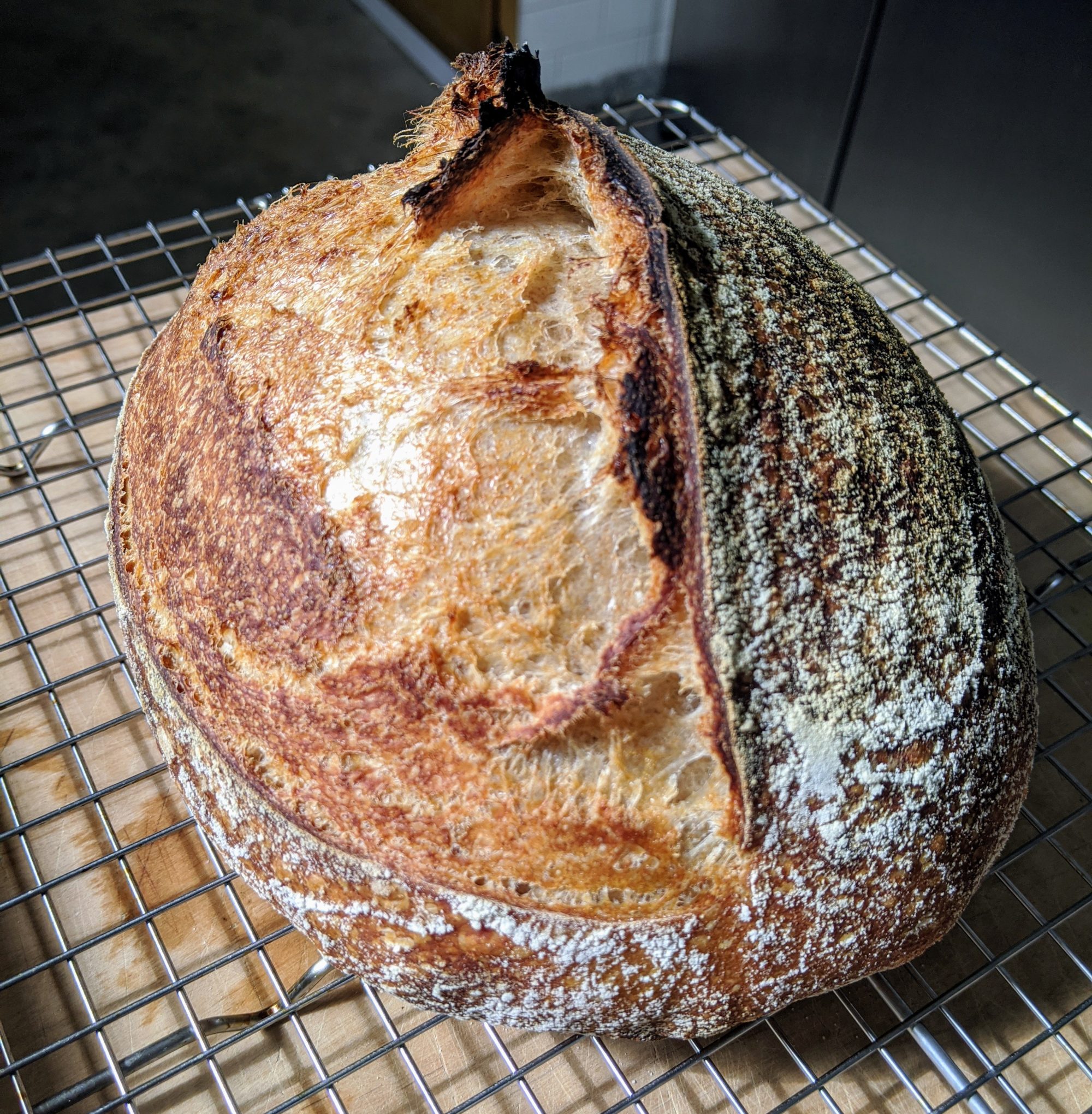
I have watched 100s of hours of YouTube videos (thanks, pandemic) and visited dozens of websites to put my bread recipe together. You may find something else you like, but this is mine. This is almost entirely following the formula on this site: https://bread-magazine.com/sourdough-bread-recipe/ Jarkko Laine has quite a bit to say on the topic of bread, so I recommend you visit his page(s).
I’ve also been influenced by Mike at Prohomecooks.com: https://www.prohomecooks.com/
He offers a SourdoughU online class (that I didn’t take), but he’s a very prolific YouTuber and has tons of videos about Sourdough and everything else cooking. My timings for my bake come from his Sourdough Baking Guides, available for free download here: Sourdoughu Baking Guides
I also like https://www.bakewithjack.co.uk/ He is also primarily a YouTuber and teacher based in the UK. He has a bunch of troubleshooting videos if you run into a problem
Anyway, here’s how I bake Bread:
I use “bakers math” to bake my loaves. My standard 1 kilo recipe makes 2 loaves in my large oval bannetons and with the big Dutch oven. I modify that standard recipe to a 800 gram recipe for my smaller oval bannetons and double Dutch oven. I also divide the below recipe when I wish to bake 1 loaf of bread.
My Ratios (from https://bread-magazine.com )
85% unbleached AP Flour = 850g unbleached AP Flour
15% whole wheat flour = 150g whole wheat flour
70% filtered or distilled water = 700g filtered or distilled water
25% ripe sourdough starter = 250g ripe sourdough starter
2% kosher or sea salt (no iodine!)* = 20g salt
*Note on the salt. I like a slightly saltier taste to my bread, so I typically use 25g salt.
I will assume you have followed my directions on beefing up your starter and are ready to go.
You will also need
- A very large mixing bowl
- A plastic bowl scraper
- A digital scale
- 2 bannetons, lightly floured. ( I follow the suggestion from several sites to use rice flour as it won’t produce any gluten as it interacts with your loaf and therefore won’t stick the loaf to the banneton, but you can use regular flour as well).
- A large Dutch oven
- A razor / lame or very sharp knife. I bought a lame as I wasn’t terribly comfortable holding a razor blade in my bare hand.
- Your trusty chopstick
- Time (LOTS of time, but it’s mostly just waiting)
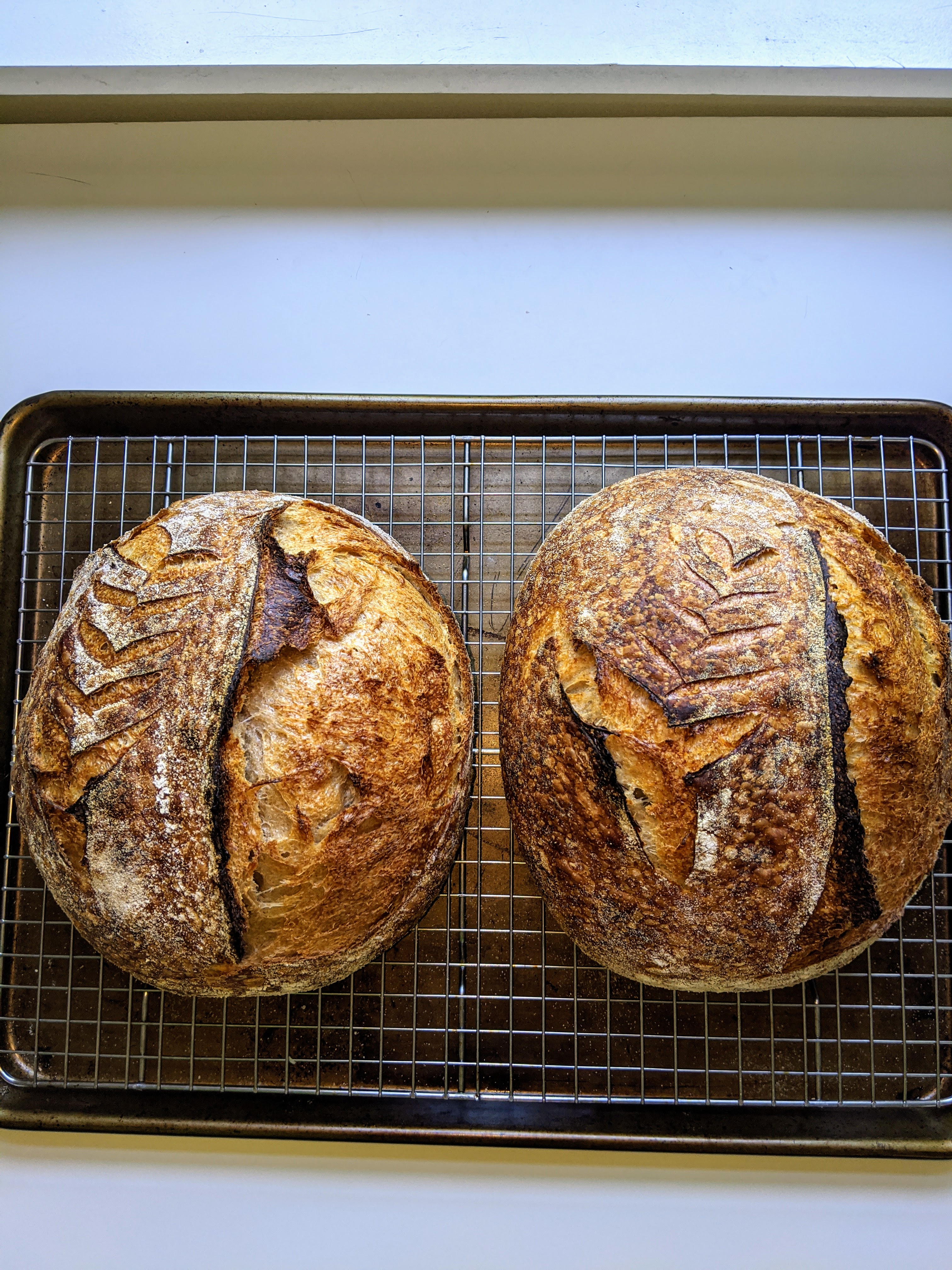
MIXING THE DOUGH
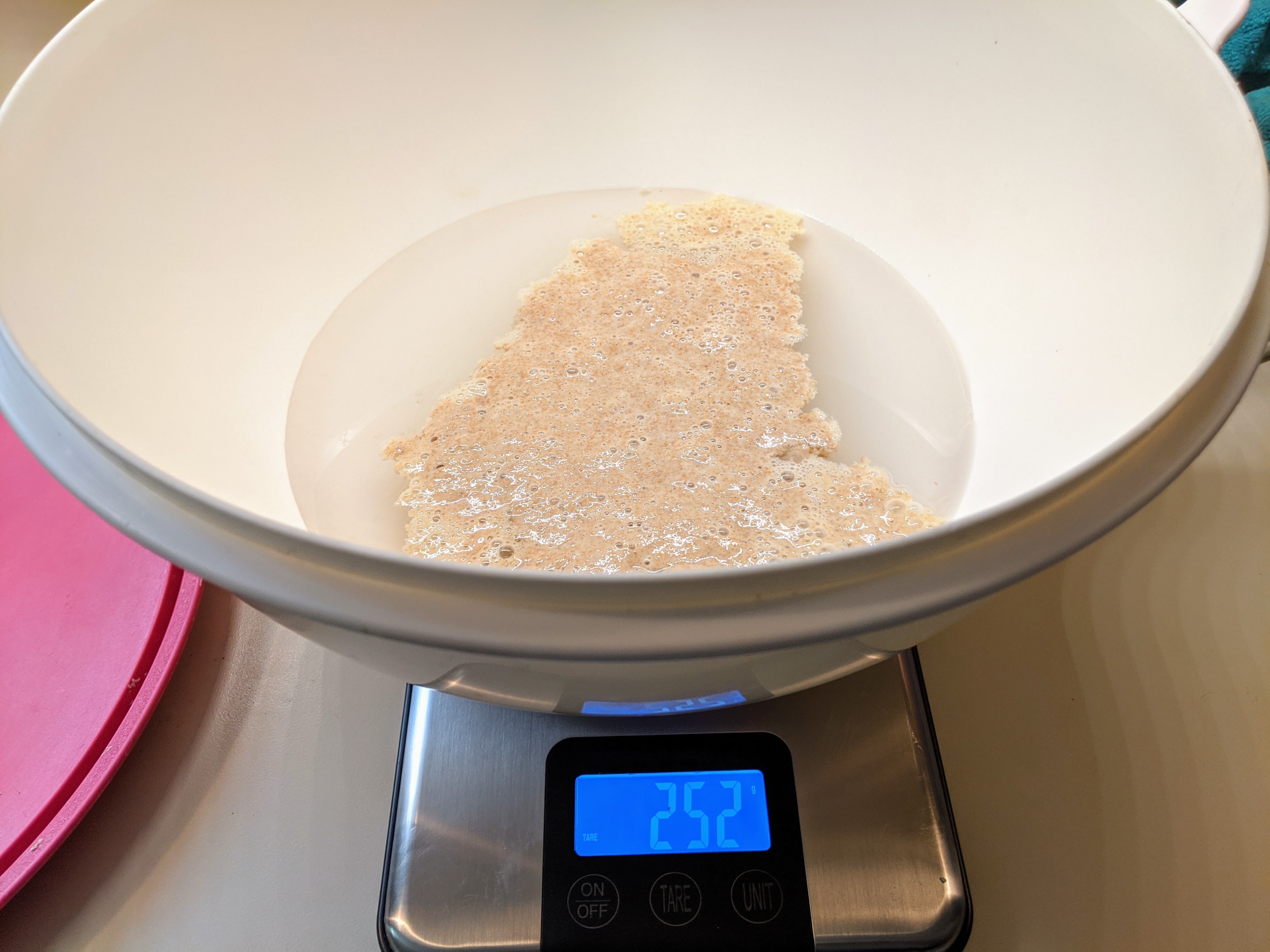
- Mix your starter with your water in your mixing bowl and use your scraper to “chop up” the starter to combine it with the water. You do not need to completely dissolve your starter, but this makes it easier to combine with the flour.
- Add your AP and Whole Wheat flour.
- Using your scraper in a folding motion, combine the flour and water until you get a shaggy dough. This will look a little rough, but that is fine. Just ensure that there are no pockets of flour or no areas that are a lot more hydrated than others. A lot of people do this by hand, but I find that the scraper keeps more dough in the bowl rather than my hand. A very handy trick is to dampen your scraper and hand with water. Use the chopstick to scrape the dough off of the scraper and your hands.
- Let the dough rest covered with a tea towel or with the lid of your mixing bowl. This step is called Autolyse and makes the dough MUCH easier to work with. Some bakers say you should let the dough rest for 30 minutes, some 1 hour. I’ve let this go for up to 2 hours without issue, but usually autolyze for 1 hour.
- Add the salt in 2 batches, by stretching and folding the dough with your scraper. Dampen your scraper and slide it under the dough, lift, stretch and fold that “corner” over the dough. Turn your bowl ¼ turn and do it again, turn ¼ and repeat until you do not feel any of the granularity of the salt. This will take several stretch and fold turns, but this is the most work you will have to do. Cover and let rest.
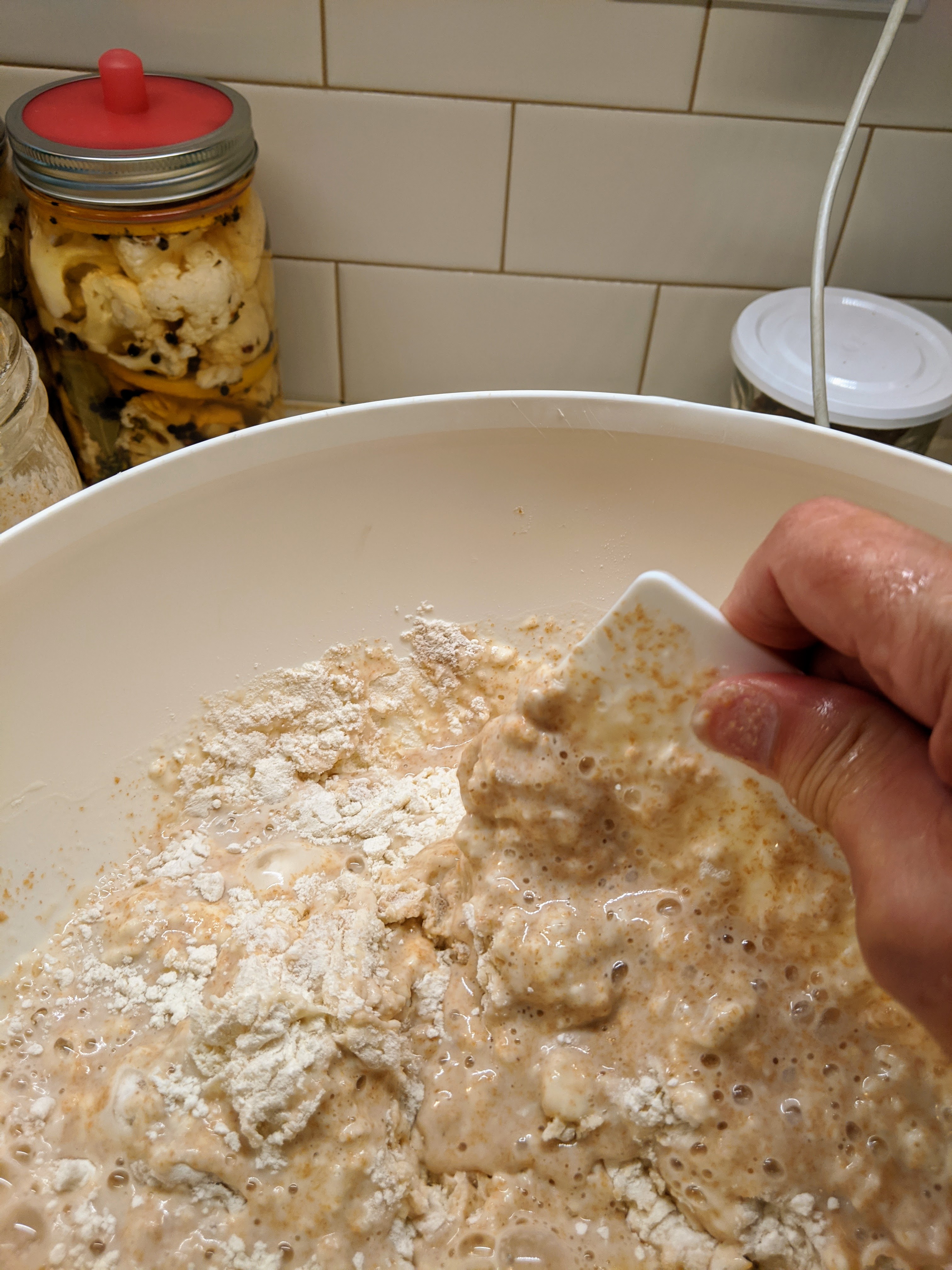

Stretch and fold and bulk fermentation.
Over the next 2-3 hours you are going to stretch and fold the dough to build the gluten. Gluten is required to trap the gas inside the bread so that it will rise. You can do this by kneading the bread over a period of 15 minutes all at once, but that is too much work. Some folks say to pull the bread out of the bowl and do it on a damp counter or a floured surface, but I do it in the bowl. I use my hands for this instead of the scraper because it provides more control.

- Dampen your hands and slide it under 1 “corner” of the dough. Lift and stretch it HIGH and fold over the dough, repeat 3 times until you have stretched and folded all 4 “corners. I generally have to use both hands by the time I’ve gotten through the 4th “corner” as the dough is no longer sticking to the bowl to provide a good stretch. Cover and let rest. Recipes call for rests of 30 minutes to 1 hour between folds, I generally fold ever 30 minutes for 2 ½ or 3 hours, so 5 or 6 fold periods.
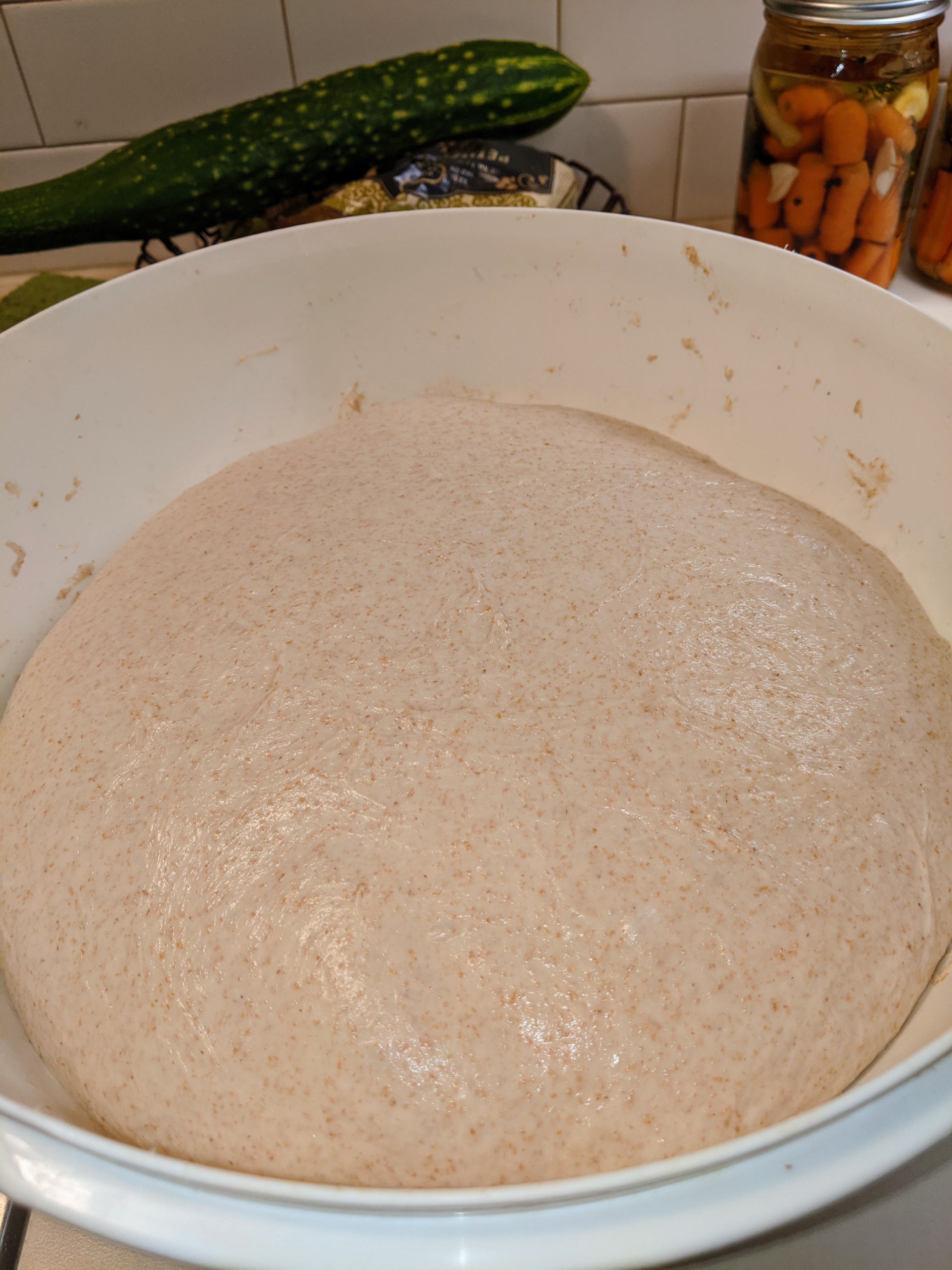
- After completing the last fold, you are going to cover the dough and let it rest. (This is an update) for a MINIMUM of 4 hours to let the starter do its work and grow. I have sometimes let my bread go for as long as 9 hours before shaping. I have NEVER had my bread double in size (but it’s gotten close), so the amount of growth is not a good indicator of when your dough is ready for the next step. You just have to keep an eye on it, and when it looks like it has grown a fair bet dampen your finger and poke the dough lightly. If it makes a dimple that then slowly rises back, your dough is done. If it springs back quickly, it needs more time. Try the poke test every 30 minutes or so until the depressed area rises slowly. My favorite description of this is if the depression rises as if it’s “waking from a long nap”
Shaping your loaves
Now you are going to shape your loaves. There are TONS of videos out there about how to do this, but this is how I do it:
- Lightly flour your surface. I like to use a pastry mat. It’s easier to clean, and it reminds me of my mom (who always used one exactly like the one I have). I frequently add more flour to the surface while I’m shaping.
- Using your scraper move your dough from the bowl to the surface.
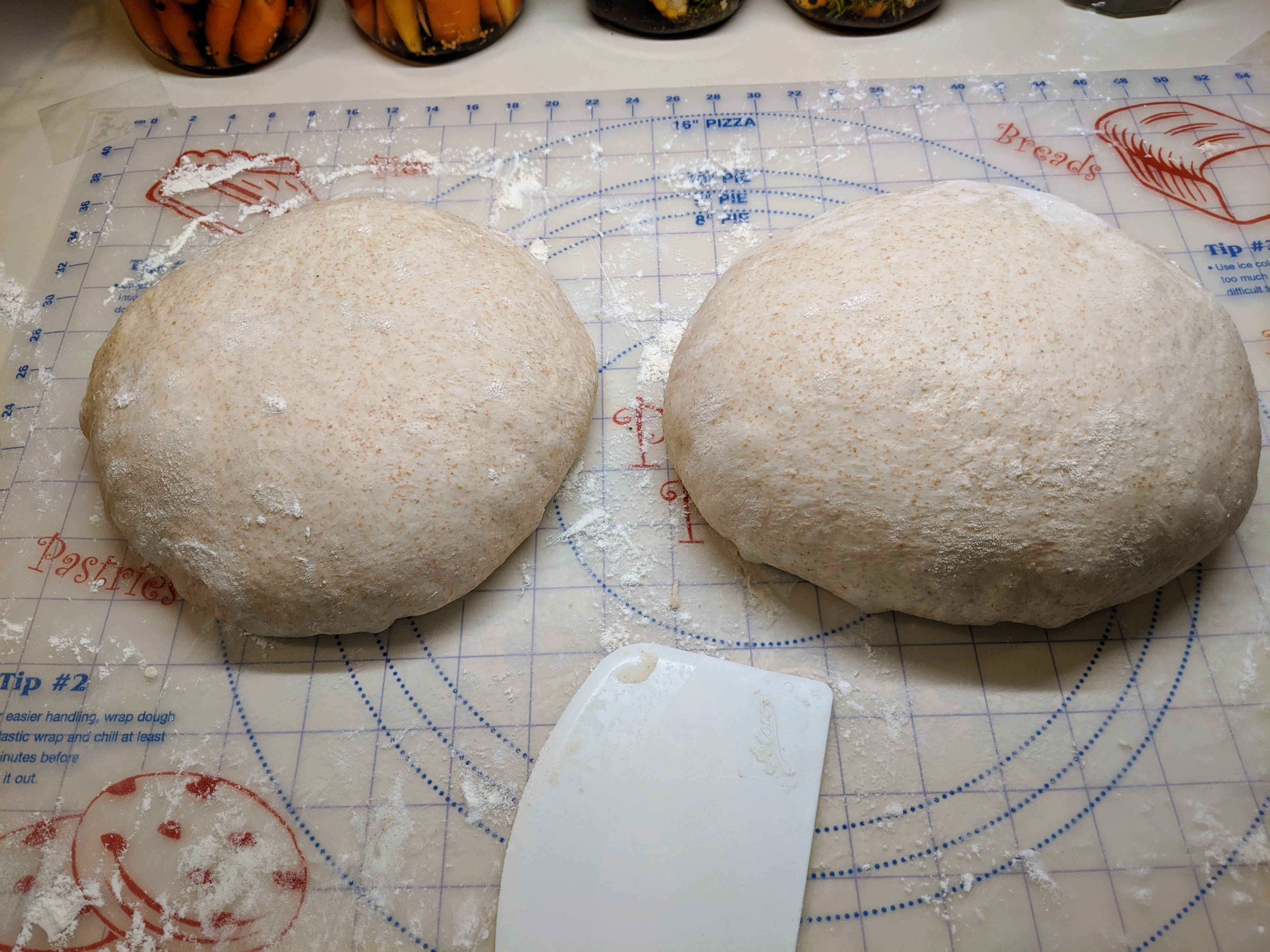
- Using your wet scraper cut the dough in 2 even sized pieces gently pulling them away from each other as you cut.
- Gently stretch and shape the dough so that it is a rough, fairly narrow (about 5 inches or so wide, about 9-10 inches long). Ensuring that you have enough flour below your loaf and flour on your hands, pick up the top right corner of your loaf, stretch it a little bit and fold it about 1 inch or so towards the center of your loaf, sticking it down lightly. Repeat with the top left corner. Move about ½ inch down and repeat on both the right and the left. Repeat until you have about 1 inch at the bottom of the loaf. Pull that bottom inch gently toward you and fold it toward the middle. Now roll the bottom gently towards the top. It should all stick together and now you have a lightly flowered, slightly oblong loaf. Flowering your hands and the surface again, cup the dough and slightly turn it around in a ¼ circular motion on the surface, lightly tucking in towards the bottom as you turn. Continue this until you have a nice tight little ball.
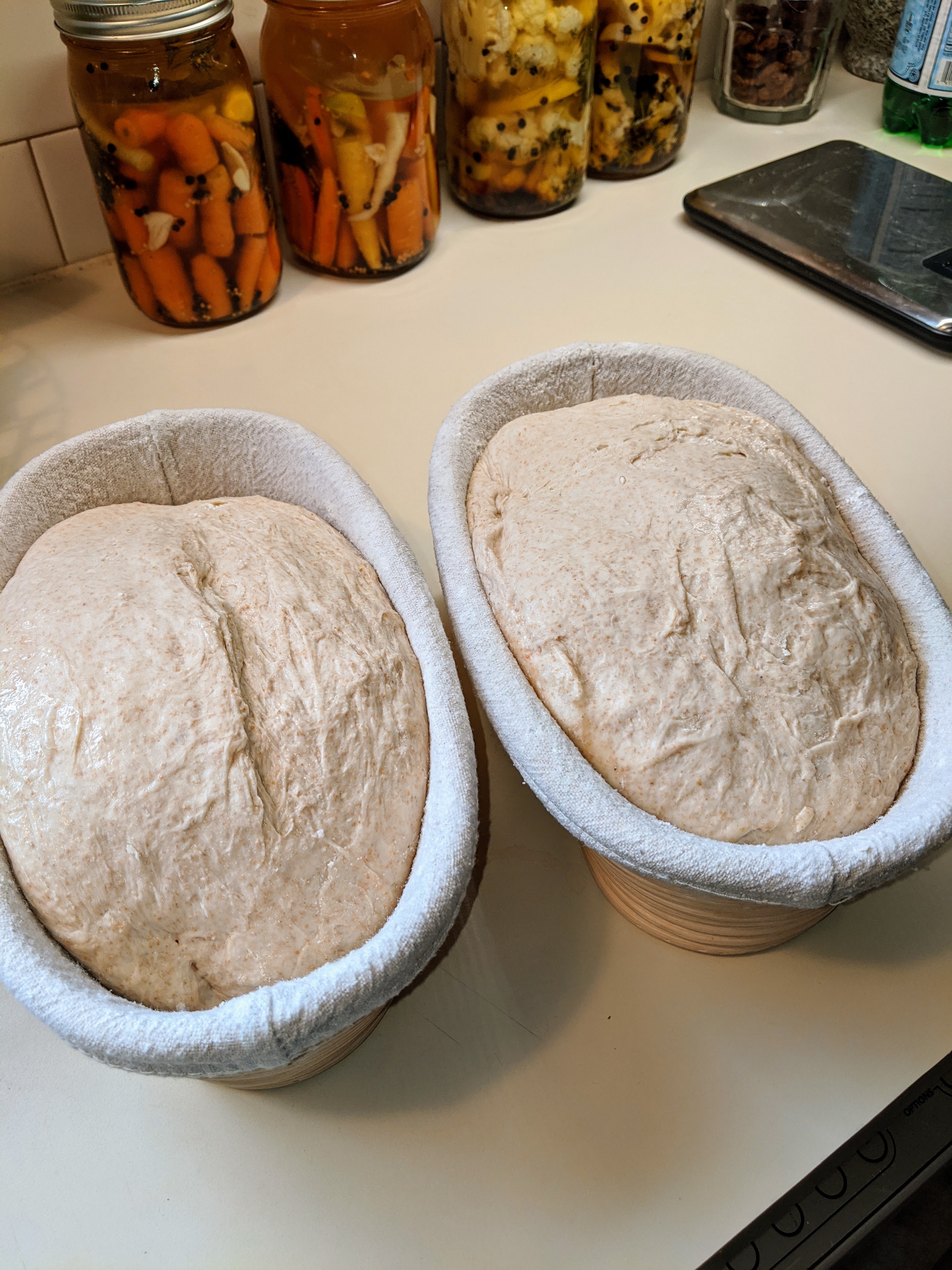
- Pick it up and put it in your banneton and cover.
- Repeat with 2nd loaf.
- Cover with a tea towel or a large plastic bag. I saw a hack to use disposable hair bonnets, and that was a game changer. Up to you.
- Place in the fridge overnight. This long rest (the cold stops the fermentation, so it won’t rise much) supposedly really amps up the flavor of the bread).
Bake!
- Place your Dutch oven into your oven and preheat both at 446 degrees Fahrenheit (260 Celsius) for at least 30 minutes, but I prefer an hour. You want the Dutch oven screaming hot.
- Take your dough out of the fridge, remove the plastic covering, and let warm on the counter while the oven is preheating.
- Carefully remove your screaming hot Dutch oven from the oven.
- Quickly center and then turn your banneton over the Dutch oven so that the bread plops into the Dutch oven. A lot of people say to turn your bread onto parchment, and the gently lower the parchment into the Dutch oven. My experience is if you have any condensation on the bottom of your loaf (the top of the banneton) that it will fuse with the parchment paper and will be impossible to remove post-bake. Another tip is to sprinkle some semolina flour into the bottom of the Dutch oven to prevent the bottom from overbaking before the top is done. I will frequently do that, but it’s not a requirement by any means.
- Take your lame or razor and cut the loaf across the top of the bread. There are many ways to do this, some of them quite decorative, but I go for the general long slight curve, like a Mona Lisa smile.
- Cover your Dutch oven and place it in the oven and bake for 25 minutes.
- After 25 minutes, remove the lid and place the Dutch oven back into the oven for an additional 25 minutes.
- 1st loaf is done! Remove it from the Dutch oven and put the Dutch oven with the lid on back into the oven for 30 minutes. This will allow the lid to come back up to temperature with the bottom.
- Repeat steps 3-7 for loaf 2.
- Let loaves cool on a wire rack for at LEAST an hour. If you cut the bread while it’s still warm, all of its moisture will escape as steam, and it will turn into a rock within hours.


To keep my loaves fresh, I wrap them in a clean, dry tea towel and put them back into the Dutch oven with the lid on. My loaves will generally last 4-6 days when kept that way, but if it’s particularly warm, they tend to get a bit moldy after 4 days. If you keep your loaf on the counter or in a paper bag, it will turn into a rock in 2 days. If you keep it in a plastic bag, its sure to mold within 3 days (and be damp). The Dutch oven storage is the best storage I have devised.
 Barry Bakes Bread
Wow! What a great step-by-step tutorial and “some” of the secrets! You posted some great photos of what to expect or how it should turn out. Thanks for sharing your knowledge of baking bread! Especially for us beginners. Great work Barry! Thanks and Happy Baking!
LikeLike